 By Lucy
 By Lucy
If your feed’s suddenly full of dog-ear filters, grainy photos of avocado on toast, and Euro trips in skinny jeans, you’re not alone. TikTok’s in a full-blown 2016 nostalgia spiral, with #2016 racking up millions of views.
We talked about nostalgia being a big trend in our last (and Stranger Things themed) episode of the The Brief, and it’s no coincidence. Experts say it’s less about the mems and more about the vibe — 2016 was the last time life felt carefree, before AI dread and whatever’s going on with Instagram.
If you’ve re-opened your laptop, stared at a blank Google Doc and briefly considered a career change — congratulations, you must be back at work in 2026. If you need a little help with what you should be focusing your time on or what to expect digital marketing-wise in 2026, this article may help point you in the right direction. It pulls together the big picture stuff, including what platforms are doing, where attention’s going, and what might shape your strategy this year.
A few things worth taking note of:
Reels now make up half of Insta’s time spent, and YouTube Shorts are pulling 200 billion views a day. It’s the golden age of swipe-sized dopamine. If you’re not in it, your ads at least need to be.
Snapchat’s glasses will be launching this year, allowing you to put digital overlays onto your physical world, with Meta’s Orion glasses not far behind. Here’s to ignoring reality, increasing our screen-time and burning images into our retinas. Yay!
People are getting wise to what’s fake, and questioning everything they see, and it’s making them cranky. Platforms are now racing to let you block AI content, while brands are quietly re-learning how to sound human again.
Our tip: You don’t need to swear off AI tools. But don’t hand them the keys to your content calendar either. Let your brand feel like a real person again, and be very transparent when AI is used.
Everyone wants a piece of Reddit now that ChatGPT and Google’s AI results are pulling answers from its threads. Marketers are trying to sneak in “organic” product mentions. Brands are launching Reddit strategies. Reddit users are not so thrilled, which is likely to see a change in how Reddit oversees its content.
With more countries moving to restrict under-16s from using major social platforms, there’s a growing gap – and someone’s going to fill it.
Kids aren’t going back to writing in journals or talking via can and string. They’re going to find (or build) new apps, and new ways of staying connected digitally. Keep an eye on what emerges from the fringes.
Of course, I’m of the opinion that copywriting has always been cool, but this article is good for anyone in the content writing realm who is still trying to justify their worth…
As Andrew Holland shares, AI has not killed writing, but it has exposed badly-written, soulless SEO designed to rank rather than covert. This year, content will be all about clarity, persuasion, and proper positioning, which is the kind of stuff AI tools still struggle with.
As we have said ad nauseam, write for humans over algorithms, and you’ll always be in a good spot.
On the back of their annual Wrapped, Spotify has decided to start leaning harder into interactive experiences.
They’re trialling interactive playlist prompts, seasonal listening recaps, artist shout-outs, music trivia, and even premium access for superfans — think exclusive content, early drops, and VIP messages. It’s less streaming platform, more social playground.
The goal is to keep users emotionally engaged and opening the app, even when they’re not actively listening.
But behind the scenes, it’s not all smooth streaming. Alongside an announcement to increase prices in the US, Spotify’s stock has slid over 13% in the past month and nearly 30% in the last six, with investors spooked by rising costs and user pushback — especially over the quiet flood of AI-generated music hitting the platform.
Many of these AI artists aren’t even labelled as such, leaving listeners unknowingly streaming tracks made by bots, and some aren’t happy about it. While Spotify says it’s not their job to tag AI content, critics argue it erodes trust and makes supporting real artists harder.
Our Creative Director Lloyd Seymour is a longtime music producer (Against The Grain Records), and artist behind DJ Skool of Thought. He uses the platform both as an artist and a listener.
“I think it’s a big mistake,” he says. “We are seeing some artists remove their content in protest, and it leaves the door open for a competitor to take a no-AI stance on principle – and I think a lot of people would switch for that. So it might be an “own” goal for Spotify.”
So, as Spotify builds out more interactive features to drive engagement, our biggest questions are: who (or what) are we really listening to? And what are they going to do about rebuilding our trust?
As part of its Dry January campaign, Heineken rebranded parts of London’s Bakerloo line to “Bakerl0.0” and “Waterl0.0” — a play on its alcohol-free range.
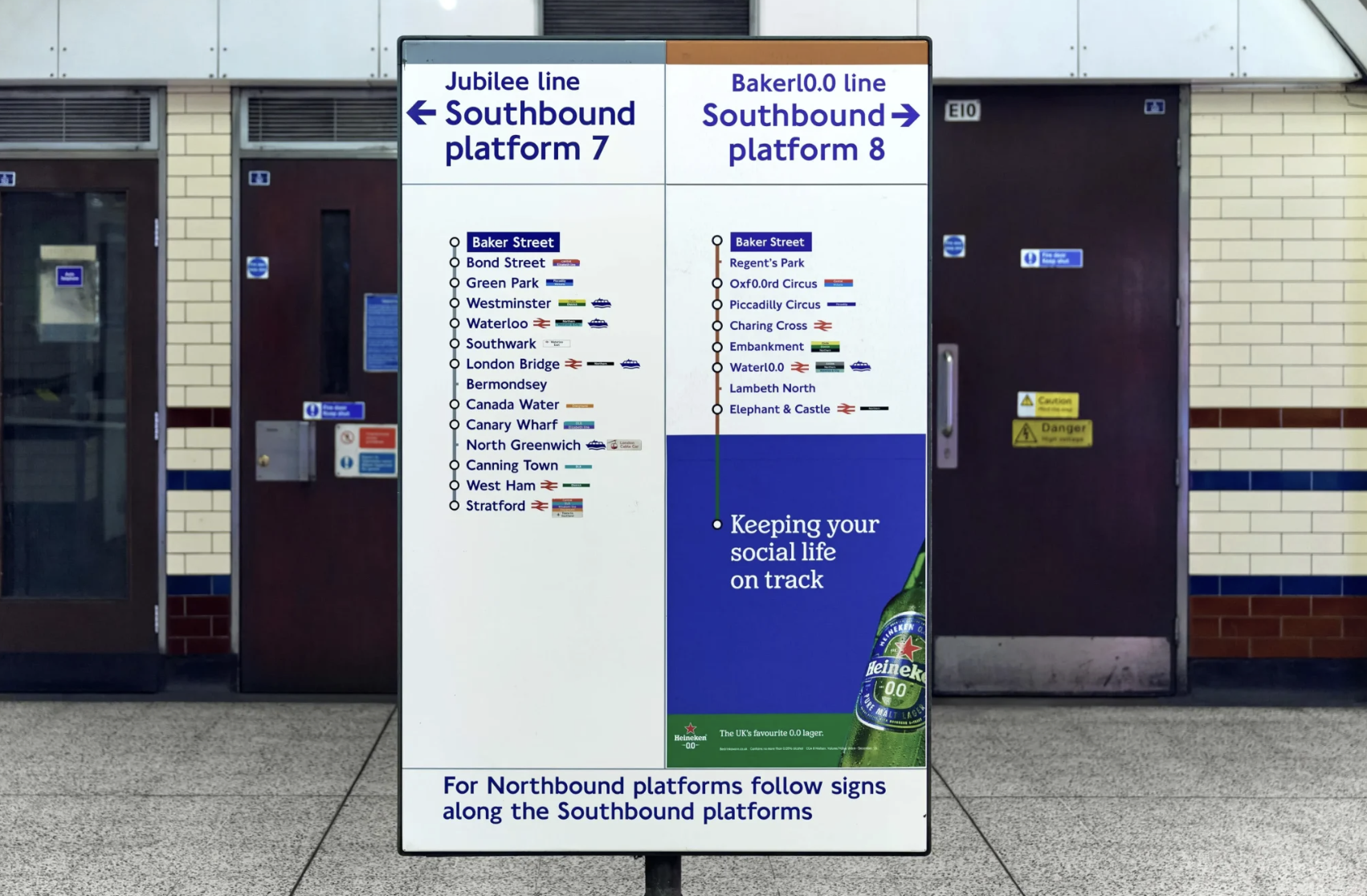
Clever? Definitely. Immersive? Absolutely. But not everyone’s onboard.
Disability advocates raised concerns about the confusion this could cause — particularly for those with vision impairments, neurodivergence, or fatigue — who rely on clear, consistent signage for safe travel. Others are not a fan of the commercialisation of a public space.
This is part of a growing trend: TfL briefly transformed Oxford Circus back in 2020 for the UK launch of the PlayStation 5, swapping roundels for the iconic PlayStation symbols (✖️🔵🟩🔺), and Burberry took over Bond Street and Old Street in 2023 for London Fashion Week while Samsung Fold took over Old Street Station in 2024 (though the last two did land TfL some fines.)
We love a bold brand moment (and the London underground and overground is home to many), and these particular takeovers work by making the public feel like they’re part of an inside joke. But is the idea worth the risk of confusion and reducing accessibility? In our opinion, the key lies in exploring how the idea or activation may be experienced by all audiences before green-lighting it.
We came across this deck from TfL. which showcases some case studies from their commercial partnerships (sans the bits about the fines).
ICYMI, Pantone’s 2026 Colour of the Year is “Cloud Dancer” — a fancy name for… white.
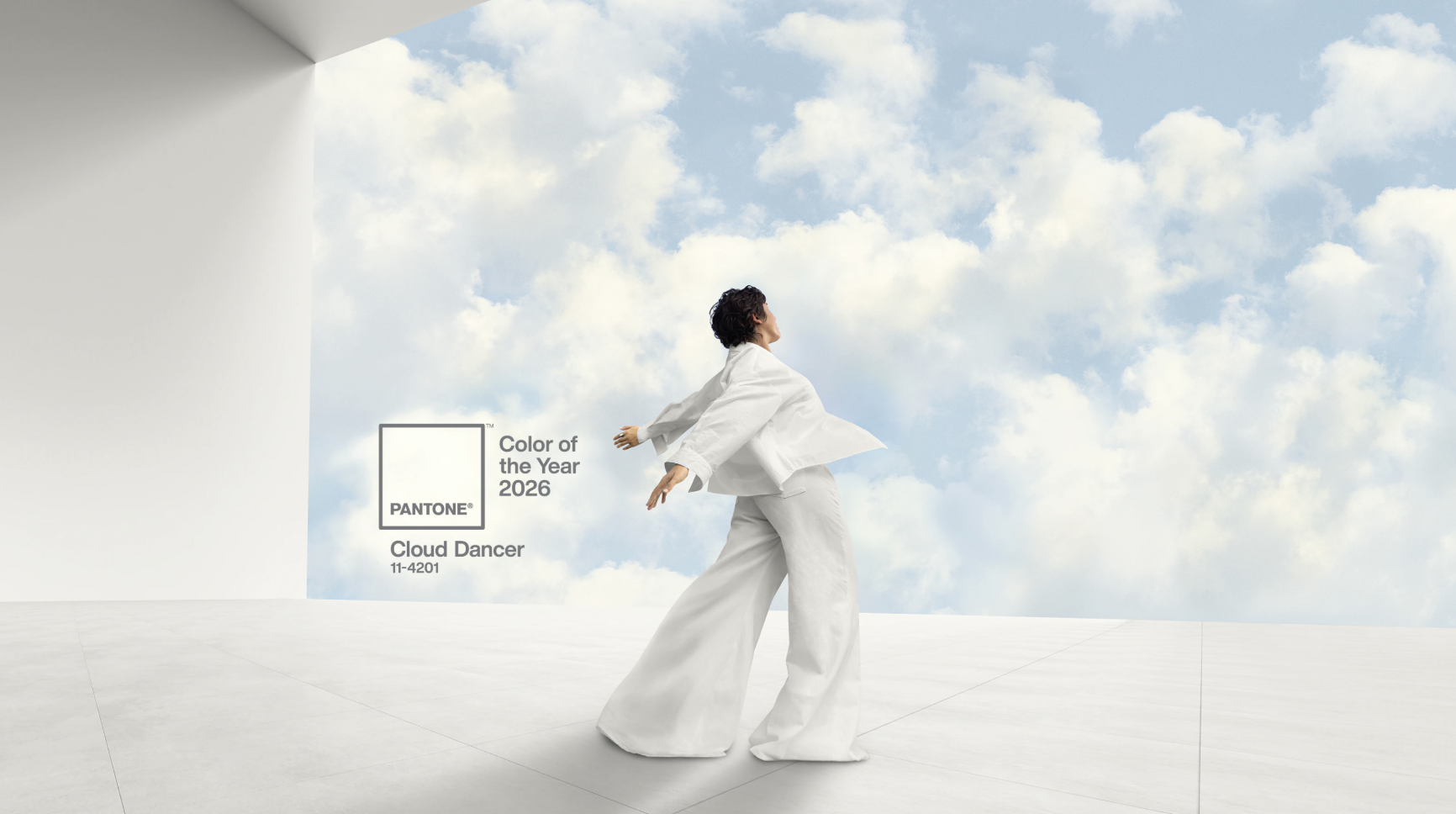
Minimalist, sure. But is it also a little tone deaf in a year where people are begging for a little more warmth, joy and, well, colour?
Meanwhile, Pinterest dropped a data-backed palette grounded in actual user behaviour. Decoding aesthetic patterns from billions of searches and saves, they came up with 5 colours for the year: Wasabi, persimmon, jade, cool blue and plum noir.
We’re not here to pit them against each other, but… one clearly understood the assignment.
If you love what we’ve shared above and want to be kept in the loop with our weekly email, The Brief, you can sign up here. We’ll only send you things we love and think you’ll find useful, and you can unsubscribe at any time.
And if you need some help exploring any of the above within your own marketing strategy, or you need a rebrand, a custom website built from scratch, Google or social ads, print materials, blog posts – or the whole lot – we’d love to chat.
Drop us a line here.