
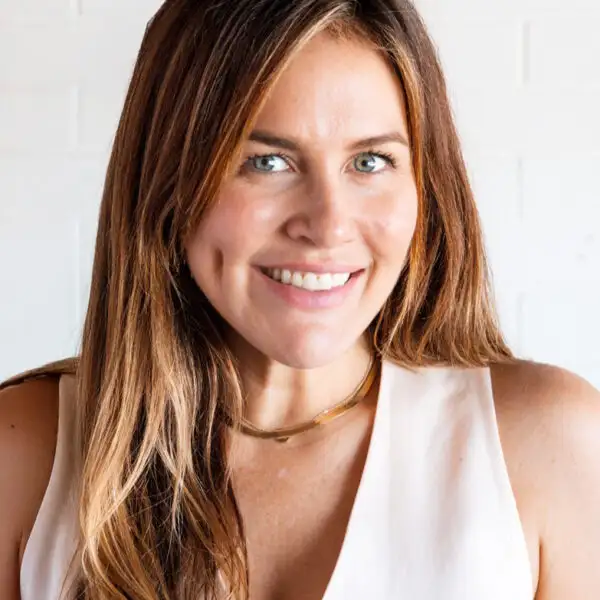
 By Lucy
There is a certain kind of confidence that does not need to announce itself. You can feel it in a calm voice. In a steady hand. In a beautifully considered space. In a well-made suit or a beautifully cut gown.
That kind of confidence runs through Sam Burgess and her business approach; knowing what to test, what to leave behind, and when to trust instinct over certainty. It is a mindset that has helped shape one of Brisbane’s most distinctive wedding dress shops and bridal destinations, Bloom Australia nestled on Commercial Road in Brisbane’s Newstead.
“One of the things I try to do is figure out a way to test without it being too much of a loss,” she says.
“Some risks are really expensive, right? But I also try to put a framework around them to be, like, all right, what is the time frame on this? What can we learn from this?”
“But I think for me, one of the most important things that I’ve learned is that you have to go with your gut a little bit.”
From Fashion Buyer to Bridal Founder
Before Bloom, Sam had spent most of her career on the business side of fashion.
“I was a buyer for most of my career for almost 15 years. I was a buyer at Macy’s, which is a big department store in the US. And then I moved to Melbourne and I was a buyer for Cotton On and Target Australia.”
Later, she moved back to New York and into wholesale where she was Vice President of Wholesale for a fashion house working with different brands and buyers.
That background gave her a commercial grounding that would become essential once the business was her own.
“I do think that that was one of the things that got me by in so many ways. I think what got me through was my ability to understand a P & L [Profit & Loss], my ability to project sales, what was going on and to manage my cash flow.”
A Business Born in Uncertain Timing
Bloom may have launched during Covid, but Samantha’s story is less about the timing and more about what she made of it.
“Everything was a mess in New York City… I decided my husband’s country [Australia] sounded like a good time,” She says.
“So we left. We were on one of the last international flights coming from LA into Australia. Did the two week quarantine, and I actually spent my quarantine refining the business plan for this business and starting the conversations with designers.”
“And somehow we ended up here and I opened in August 2020.”
Intentional Fashion
What drew Samantha to bridal was not just its beauty, but its rhythm and restraint. After years in fast fashion, the appeal of something more intentional was immediate.
“I really liked the business model around bridal. I liked the fact that designers, for the most part, come out with one collection every year and brides come in and they try on a sample and everything is made one at a time.”
She also speaks candidly about what the move away from fast fashion meant personally.
“I spent a lot of my career in fast fashion, and to be honest, it keeps me up a little bit; the amount of polyester landfill that I could have potentially contributed to.”
“So I liked that bridal was a bit more specific in that way… that it’s more intentional.”
Listening Closely, Pivoting Carefully
If Sam’s approach to risk is grounded in instinct, it is equally grounded in observation.
As Bloom found its footing, she noticed that customer demand was already shifting. While the store opened with a more contemporary, fashion-forward feel and slightly more mid-tier pricing, it quickly became clear that brides were responding to something more elevated.
“I noticed quite quickly that more of the higher tier pricing was what was moving..that was what people were asking for on social media. And so I started moving more and more into that space, ” she says.
“I think it’s good to have a point of view and to have your niche and not try to be everything to everyone.
“But it’s also really important to listen to your customers and like, yes, look at what the data is telling you, but listen to them: what are the problems that they’re trying to solve?”
The Risk That Shifted Bloom
So when the chance came to take on a major designer at a much higher price point, the intuition was already grounded in what she was hearing and seeing from customers.
“I did the math, and the gowns were much more expensive than I had any open to buy for,” she says.
“I knew it was a huge risk, but I just knew from a fashion perspective that this designer was important and it would be a big deal for me to have them.”
“And I just knew. I knew in my gut that it was the right thing to do.”
“It was a massive financial investment for me.”
“I feel like I’m really good with money. But I also know that in fashion, you can’t just rely on numbers to tell you what to do.”“And I just knew that it was going to work out. I could see how excited people were. People were making trips to come see us, to see this designer. And I was like, hey, I’m onto something. I think I’ve done the right thing.”
The Right Hire Before She Was Ready
Growth brought another defining decision: Samantha’s first hire.
“My first hire approached me, a beautiful woman named Kait, who I’m still really close with today.”
Samantha recognised immediately what Kait could bring.
“I met her for lunch, and I just knew right away that she knew all of the things about bridal, all of the nuances that I was still learning, whereas I felt like I had the business side really down pat.
“But the bridal specifics were new to me. And she was a pro.”
So she made the call, even before it felt fully comfortable.
“I actually had her on the payroll before me. I started paying her before I paid myself, because I knew even though I wasn’t financially ready at the time, I knew we were poised for growth, and I knew if I didn’t hire her, someone else would. I knew she was a risk I was willing to take.”
It was another moment where instinct, timing and commercial judgement came together.
“The cool thing about fashion is that it’s quite easy to test a couple of trends here and there”
“You have to go with your gut a little bit and just make sure that it’s going to make sense in some way, shape or form. And being able to pivot when it doesn’t.”
“I feel like so many people are so afraid to take risks and their businesses stay stagnant,” She says.
“And don’t get me wrong, I’ve tested a lot of things that haven’t worked, but I’ve tested some things that have been amazing and changed the trajectory of my business.”
What Wasn’t Worth Expanding
As Samantha says, not every test was worth repeating.
She trialled custom bridesmaids gowns and soon discovered that what sounded like a natural extension simply did not make financial sense.
“They were beautiful bridesmaids; the wedding was beautiful. But it was a huge financial hit for us.”
“There was a lot of communication back and forth. Obviously, the price point of bridesmaids dresses, in most cases, is a 10th of what a bridal gown is. There’s so many variables.”
“There was no money in it. And the opportunity cost was big as well.”
It is one thing to broaden the offer. It is another to do it at the expense of the core business.
Protecting Energy, Creativity and Perspective
There is also a strong thread in the conversation around energy, and how Samantha thinks about showing up well.
A former competitive volleyball player, she still sees movement as essential to how she functions at her best, whether that is strength training, a Peloton session, or simply walking her dog.
“For me, I know that my brain functions better if I move,” she says.
But the bigger shift came when she realised that constant busyness was crowding out the strategic and creative thinking the business needed from her.
“I was exhausted and totally burnt out; I was pretty much only doing the stuff that I needed to truly keep the business afloat.”
“I realised that six months had gone by and I hadn’t done anything particularly creative for the business, I hadn’t thought strategically, I hadn’t had any high level conversations with any of either my colleagues or designers that I work with, or future designers that I wanted to work with.”
“I read a book called Stolen Focus by Johann Hari,” she says.
“One of the things that he does talk about…is how in order to do your best work, you have to be rested and have to also be spending time doing things that you love.”
Watch Risky Business, Episode 10:
Related News
News
The Brief
Instagram wants your TV, AI wants your wallet, and Tinder wants a second chance.
Marketing, digital, design and tech news for July, 2026.
Read More 
Article / Creative / Interview
Risky Business, Episode 11 | Teamwork & Trust in the Music Business with Krafty Kuts
Renowned producer and DJ Krafty Kuts sits down with our Creative Director Lloyd to discuss building effective teams and the evolution of the music music.
Read More 
The Brief
Gemini Omni Is Blurring Reality, YouTube Is Labelling It, and Spotify Wants Receipts
Marketing, digital, design and tech news for June, 2026.
Read More